In my latest piece on the National Geographic website, members of a tiny Indian hill tribe insist their distinct language is no different from that of their neighbors — and the bigger tribe agrees. In reality, the tongues are as different as English and Hindi.

Click here for more on the curious case of the Koro and the Aka. And, after the jump, see video of the Koro from the National Geographic Society’s Enduring Voices Project.

Continue reading »

Travel guide author Steve Waters, writing at the Lonely Planet website, has this to say:

The Black Nile offers a fascinating and harrowing look at a country that continually makes headlines for all the wrong reasons. Morrison does his best to explain the historical events, tribal intricacies, external pressures and internal tensions that haunt Sudan today. Ok, not every traveller can flash their press card and jump a UN chopper, but then they normally wouldn’t end up under the bed sheltering from a firefight between local militias either. Morrison’s trip through Sudan becomes a quest for understanding; an attempt to unearth the truth behind his experiences as he interviews rebel leaders and local headmen, academics and taxi drivers, archaeologists and tour guides, all the time cadging his way a little further downstream.

The forests of Bangladesh are dwindling by the day, creating a furry refugee crisis among forest-dwelling animals who are forced into towns and villages in search of food.

That’s where Sitesh Ranjan Deb comes in.  The subject of my most recent piece for Nat Geo News Watch, Sitesh is a one man International Rescue Committee waging a lonely battle to save the animals of his native land. I think you’ll enjoy this tale of a gunman turned conservationist.

(Looking for news of The Black Nile? Check out this review by Issandr el Amrani in The National, and this exclusive excerpt from The Faster Times. )

“Morrison is an agreeable raconteur, and he’s skilled at conjuring the menacing disorder of a continent dump-trucked in the Class VI whitewater of post-colonial commerce . . . The cumulative near-misses, the chronic money shortage and the moving stories have a huge impact by the time Morrison reaches Rosetta in Egypt . . . A memorable romp.”

* “A masterful narrative of investigative reportage, travel writing, and contemporary history.” – The Daily Beast


* The Black Nile “combines wit with deep reporting…Getting in and out of dangerous locations is clearly Morrison’s forte.” – BusinessWeek

* “Captures the sun-baked, hallucinatory aura that slow boat travel can induce…Excels in bringing the place, politics and history of this fragile region alive.” – The Boston Globe

* The Black Nile “avoids the evangelical zeal and naïve prescriptions other Africa books fall victim to . . . Morrison teeters dangerously close to gunfights, disease, and run-ins with the authorities while relying on former rebels, proto-entrepreneurs, and crooked bureaucrats to get him through.” – Outside

* “Adventure is only half the story in this marvelous book, and maybe the lesser half…A beautifully-written tale of an American on a journey to find out who else is out there, what they’re thinking, why they do what they do, and hey, check out that sunset with the cranes flying low across the horizon.” – Tom Robbins, the Village Voice

* “There’s enough grist in this excellent travelogue to craft a dozen killer Microkhan posts.” – Brendan Koerner, Microkhan.com

* “If you’re weary of cliched newsbites, misery memoirs and exoticised adventurism, and want more insight than disaster reporting or parched analyses can offer, this is a refreshing relief.” – Peter Verney, Sudan Update

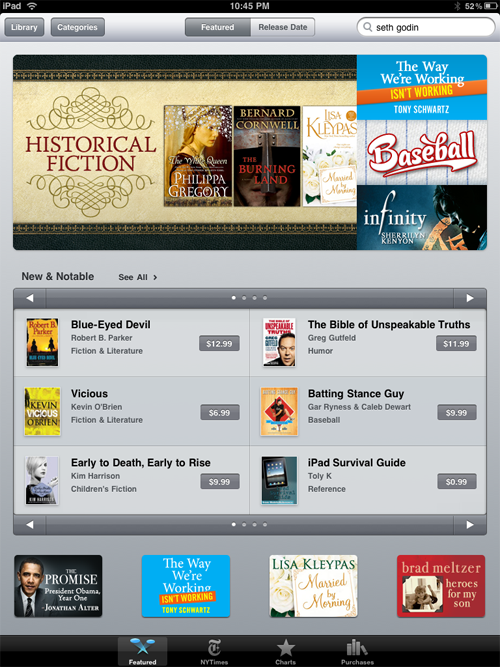
Starting today, The Black Nile will be featured as a Book of the Week on Apple’s iBookstore, available to users of the iPad, iPhone, and iPod Touch. There are millions of these devices out there, though I’ve no idea how many people use them to buy and read books. I just saw my first iPad this weekend and I’ve got to say it looks really cool. It’s easy to see the allure of the iPad, Kindle, Nook, and other e-readers, but I think I’ll be sticking with dead trees for the time being. It’s hard to scribble in the margins of an electronic ink screen.

If, like me, you still prefer hard copies to hardware, you can order a physical edition of The Black Nile from AmazonBarnes & NobleBordersPowell’s, and your local independent bookstore.

Please check out this great review by Hugh Pope in the weekend Wall Street Journal. Here’s the kicker:

Above all, Mr. Morrison’s peppery anecdotes, his refreshing honesty and his ability to show how Africans view their difficulties save “The Black Nile” from being simply a memoir of an author’s self-prescribed endurance test. Instead, the book gives us a compelling portrait of life along the Nile—from lonely fishing communities on Lake Victoria to the cacophonous collisions of Cairo. Mr. Morrison’s more discouraging encounters also quietly pay tribute to triumphs of the human spirit. Mr. Bryan, the author’s companion and verbal sparring partner for the first third of the account, later writes to him: “It’s good to be desperate once in a while. Gives you an appreciation of the looks on people’s faces when they’re desperate and you’re not.”

My newest piece, on the struggle for control of the Nile. Here’s the lead:

I was standing inside a colonial-era circuit house in a sprawling, malarial city called Malakal in southern Sudan. I had come to see a man about a river, but the man, an Egyptian hydrologist, wasn’t talking.

“It is forbidden,” he said solemnly, “to speak of the Nile.”

I pointed towards the window. “But it’s right there,” I said. This was, after all, a measuring station of the Egyptian water ministry, one of several it maintained in Sudan and Uganda to track the volume of the world’s longest river.

The hydrologist didn’t need to look out the window. He knew where the Nile was–he’d devoted his life to its study. But there was nothing he could say to a stranger about something so important to his nation’s survival. I might have had better luck inquiring about Tehran’s nuclear program.

You can read the whole article here, and check out other great writing on the environment at the NatGeo News Watch blog.

“Morrison’s narrative combines reporting and travelog in a way that brings readers to this most unlikely destination, a place of complexity, tension, struggle, and pain, where shreds of tradition and community are still visible.

“Verdict: Morrison’s account transcends the travel genre to provide authentic and timely information on a complicated part of the world. Highly recommended.”—Melissa Stearns, Library Journal

Apparently, no book is complete these days without an accompanying video. Here’s mine. I hope you like it.

The Black Nile – August 12 from Viking Penguin from DAN MORRISON on Vimeo.

© 2012 Dan Morrison Suffusion WordPress theme by Sayontan Sinha