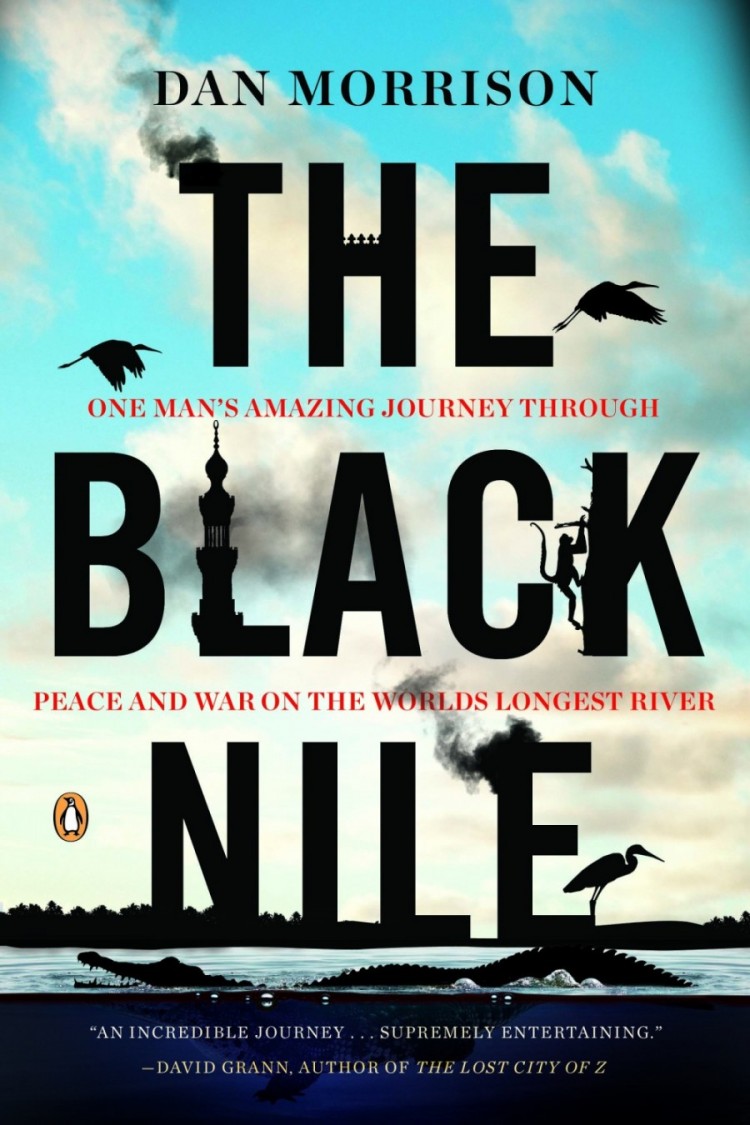
Dan Morrison takes the reader on an incredible journey in The Black Nile. Weaving together intense travel writing and history, he has produced a supremely entertaining work, and also an important one.David Grann, author of The Lost City of Z and The Devil and Sherlock Holmes

Part On the Road, part Fear and Loathing in Africa, Dan Morrison takes us with him on his journey down the Nile–teaching us, by example, to be explorers of both the world and ourselves.Kevin Sites, Author of In the Hot Zone: One Man, One Year, Twenty Wars

The Black Nile is eye-opening, breath-taking, heart-pounding and, frankly, all the adventure I’m up for now.Ellis Henican, Fox News Channel and Newsday

* “A masterful narrative of investigative reportage, travel writing, and contemporary history.” – The Daily Beast


* The Black Nile “combines wit with deep reporting…Getting in and out of dangerous locations is clearly Morrison’s forte.” – BusinessWeek

* “Captures the sun-baked, hallucinatory aura that slow boat travel can induce…Excels in bringing the place, politics and history of this fragile region alive.” – The Boston Globe

* The Black Nile “avoids the evangelical zeal and naïve prescriptions other Africa books fall victim to . . . Morrison teeters dangerously close to gunfights, disease, and run-ins with the authorities while relying on former rebels, proto-entrepreneurs, and crooked bureaucrats to get him through.” – Outside

* “Adventure is only half the story in this marvelous book, and maybe the lesser half…A beautifully-written tale of an American on a journey to find out who else is out there, what they’re thinking, why they do what they do, and hey, check out that sunset with the cranes flying low across the horizon.” – Tom Robbins, the Village Voice

* “There’s enough grist in this excellent travelogue to craft a dozen killer Microkhan posts.” – Brendan Koerner, Microkhan.com

* “If you’re weary of cliched newsbites, misery memoirs and exoticised adventurism, and want more insight than disaster reporting or parched analyses can offer, this is a refreshing relief.” – Peter Verney, Sudan Update

If you’re in New York city this evening, join me for The Black Nile’s launch party at Idlewild Books, 12 West 19th St., off Fifth Avenue, at 7pm.

Starting today, The Black Nile will be featured as a Book of the Week on Apple’s iBookstore, available to users of the iPad, iPhone, and iPod Touch. There are millions of these devices out there, though I’ve no idea how many people use them to buy and read books. I just saw my first iPad this weekend and I’ve got to say it looks really cool. It’s easy to see the allure of the iPad, Kindle, Nook, and other e-readers, but I think I’ll be sticking with dead trees for the time being. It’s hard to scribble in the margins of an electronic ink screen.

If, like me, you still prefer hard copies to hardware, you can order a physical edition of The Black Nile from AmazonBarnes & NobleBordersPowell’s, and your local independent bookstore.

Please check out this great review by Hugh Pope in the weekend Wall Street Journal. Here’s the kicker:

Above all, Mr. Morrison’s peppery anecdotes, his refreshing honesty and his ability to show how Africans view their difficulties save “The Black Nile” from being simply a memoir of an author’s self-prescribed endurance test. Instead, the book gives us a compelling portrait of life along the Nile—from lonely fishing communities on Lake Victoria to the cacophonous collisions of Cairo. Mr. Morrison’s more discouraging encounters also quietly pay tribute to triumphs of the human spirit. Mr. Bryan, the author’s companion and verbal sparring partner for the first third of the account, later writes to him: “It’s good to be desperate once in a while. Gives you an appreciation of the looks on people’s faces when they’re desperate and you’re not.”

My newest piece, on the struggle for control of the Nile. Here’s the lead:

I was standing inside a colonial-era circuit house in a sprawling, malarial city called Malakal in southern Sudan. I had come to see a man about a river, but the man, an Egyptian hydrologist, wasn’t talking.

“It is forbidden,” he said solemnly, “to speak of the Nile.”

I pointed towards the window. “But it’s right there,” I said. This was, after all, a measuring station of the Egyptian water ministry, one of several it maintained in Sudan and Uganda to track the volume of the world’s longest river.

The hydrologist didn’t need to look out the window. He knew where the Nile was–he’d devoted his life to its study. But there was nothing he could say to a stranger about something so important to his nation’s survival. I might have had better luck inquiring about Tehran’s nuclear program.

You can read the whole article here, and check out other great writing on the environment at the NatGeo News Watch blog.

“Morrison’s narrative combines reporting and travelog in a way that brings readers to this most unlikely destination, a place of complexity, tension, struggle, and pain, where shreds of tradition and community are still visible.

“Verdict: Morrison’s account transcends the travel genre to provide authentic and timely information on a complicated part of the world. Highly recommended.”—Melissa Stearns, Library Journal

There’s a reason so many Westerners – tourists and humanitarians alike  – visit Uganda in such numbers, and it goes beyond the stunning variety of natural wonders and the equally stunning toll of HIV and the Lord’s Resistance Army. It’s a wonderful place, full of wonderful people trying to eke their way out of often difficult circumstances.

Despite a modern history of war and trauma that would seem more appropriate to the capital of a much bigger country, Kampala is light of heart. It breathes. And while a sense of innocence lost may be inevitable after Sunday’s terrorist attacks, I hope the people and the government will resist a slide into fear and anger. (It may be too much to wish that this tragedy will not be used as a political cudgel. It was certainly too much to ask in the United States after September 11.) But I hope Ugandans will keep those urges and at bay.  Here’s a piece I wrote analyzing the bombings for Slate.

Apparently, no book is complete these days without an accompanying video. Here’s mine. I hope you like it.

The Black Nile – August 12 from Viking Penguin from DAN MORRISON on Vimeo.

Part travelogue, part crazy adventure tale, part political reportage: Veteran foreign correspondent Morrison and a buddy build a boat and paddle up the Nile River through Uganda, Sudan and Egypt. Morrison’s African river journey is a paradoxical mixture of awe-inspiring discoveries, eye-opening human interactions and perilous escapes.Chuck Leddy, the Minneapolis Star-Tribune

Continue reading »

I have no idea.

The New Deal and the Great Society didn’t turn America into fascist Italy or Nazi Germany, as some followers of the Nobel laureate economist predicted. Despite that fizzled prognostication, and the fact that he’s been dead since 1992, Hayek has the the  number one book on Amazon right now. What’s the deal? Did Glenn Beck talk him up? (Yes he did.) Or is it because of Hayek’s skills as a rapper? When he puts it in rhyme I find I have to agree with him over John Maynard Keynes. The boom makes the bust.

UPDATE: Champagne corks must be popping at the University of Chicago Press, where The Road To Serfdom went out of stock June 10. Amazon sold more than 13,000 copies in one day, according to The Hayek Center.

© 2010 Dan Morrison Suffusion WordPress theme by Sayontan Sinha